
Beautifully made robes are a craft of devotion and care
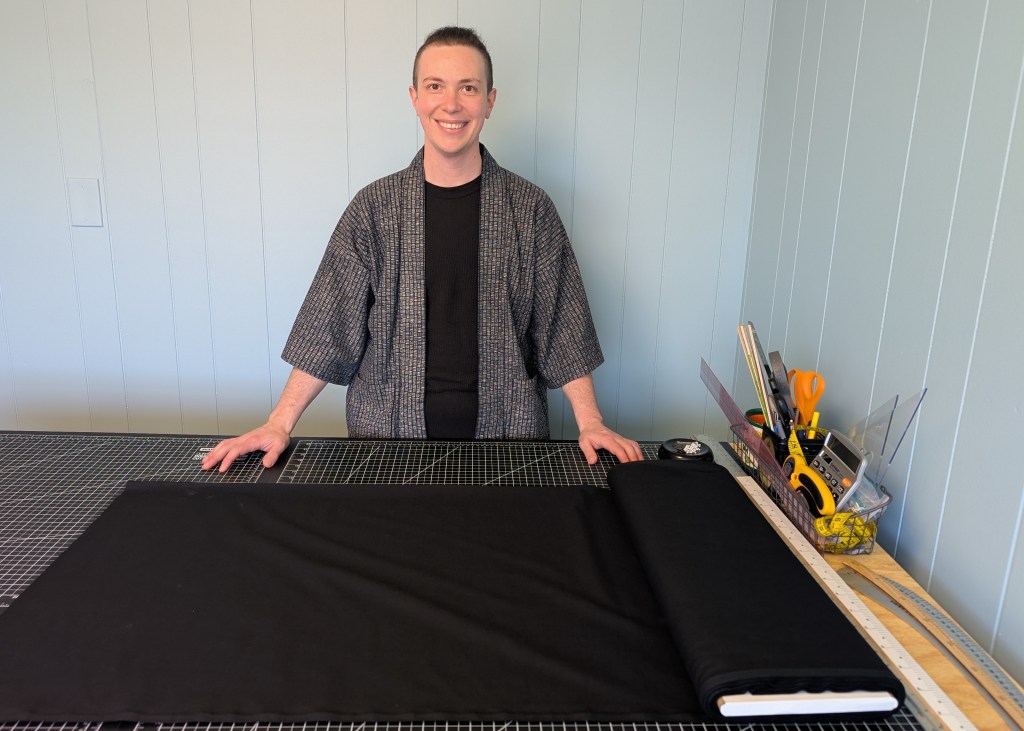
About Wesley
I have been around fabric and yarn since childhood, with my mom sewing baby clothing and knitting endless woollen sweaters, and my grandmother weaving and spinning wool. My mom taught me how to sew pajama pants as soon as I was old enough to use the sewing machine, and I have equally early memories of struggling to reach the treadles of the looms at grandma’s house. Sewing has remained a meaningful part of my life, even as I’ve grown up. Being a trans person, I’ve always had a confusing relationship with my body, and making my own clothing has been a way for me to get a fit and style that makes me comfortable. More than that, though, I’ve never stopped being in love with making things with my hands.
As an adult, disillusioned with the experience of working on a computer every day, I moved to a Soto Zen residential temple in upstate New York, where I lived for almost five years, following a communal monastic schedule. In the summer seasons I served as head of the garden, digging beds and growing vegetables, and in the winters I was a sewing teacher, guiding others through the process of making rakusu and okesa. Zen taught me how to sew as a wholehearted expression of the Dharma, the activity of caring for a piece of fabric not separate from the fabric of our interbeing.
I trained in robe making with Jakuko Mo Ferrell, who has been making robes and stewarding this sewing lineage for nearly thirty years, and I have now taken up the work of making custom Zen robes as a way of supporting myself and others on the path. I am profoundly grateful to Mo’s deep generosity in teaching me to make koromo in the family style.
I currently live with my partner in the eastern Hudson Valley, still gardening and sewing as an integral part of life.
About Zen Tailoring
One of the things that drew me to Soto Zen is the way the tradition celebrates everyday activity — cooking, sewing, chopping wood. As one of the oldest human experiences, making and mending clothing offers a continuous invitation to participate in the ongoing creative activity of being human. As I continue to learn more about the sewing, weaving, and clothing traditions of my family’s ancestral lineages as well as those of East Asia, I have a deeper appreciation of the layers of methods and meaning that are embedded in each form. The Japanese textile tradition is of course particularly important in understanding Zen clothing.
Japanese cloth is traditionally woven to the width of the human body so that it can be cut into long rectangular strips and sewn together with no waste, producing the basic kimono template. Extra fabric is tucked into folds, pleats, and seam allowances so that the garment can be altered as a person grows, or shrinks, or passes it on to someone else. This makes mending easy too. The fabric can be worn and re-worn, passed down and repaired until it becomes a rag, and then it can be used again. In this way, the wasai 和裁 (traditional Japanese tailoring) tradition manifests harmony, respect, and reciprocity in its deepest principles.
Soto Zen, too, has a rich clothing history that stretches back in Japan and China for well over a thousand years. Modern priest robes still adhere to medieval forms that have been maintained by continuous transmission through generations, even as changing social contexts encouraged new simplified styles and creative tailors adapted to wider fabric bolts and sewing machines. And as Zen enters its second century in North America, these clothes are still adjusting to the people here, both priest and lay.
My aspiration is to make Soto robes in a way that serves the needs of this moment and is in alignment with the values of these root traditions to live in harmony with all beings. Recognizing the great need for Zen practice clothing and priest robes outside of Japan, especially in styles that are not easy to find abroad and in sizes that fit all bodies, I have tried to hold the spirit of wasai in my heart by making high quality clothing that will last for many years in service of the Triple Treasures, and which can be mended and adjusted until it falls apart. All of my designs are based on examples that were made in Japan, while also taking into account the styles and standards that have developed within San Francisco Zen Center and Shunryu Suzuki Roshi’s lineage of branching streams.
I make each piece individually, to the needs and measurements of the person who orders it. Working in a way that celebrates presence and relationality supports me to live in alignment with life, and I hope my work supports others in turn.